

This is now a “Both/And” tool—using a 19th-century economic principle to solve 21st-century problems.

Pareto’s Principle (the 80:20 Rule) is the ultimate subtractive tool.
NB : A subtractive tool is a framework or method used to increase clarity and effectiveness by intentionally removing the “noise,” redundant tasks, or excess information that dilutes your primary focus.
It is named after Vilfredo Pareto, a 19th-century economist who realised that 80% of consequences approximately come from 20% of causes. In a world of digital “more,” the Pareto Box helps you filter to find the “vital few” that move the needle.
How can it help me?
The principle is a rule of thumb, not a law of physics. It brings clarity to complex systemic problems by showing you exactly where to focus your effort and—more importantly—where to stop.
The 80:20 Rule in Action
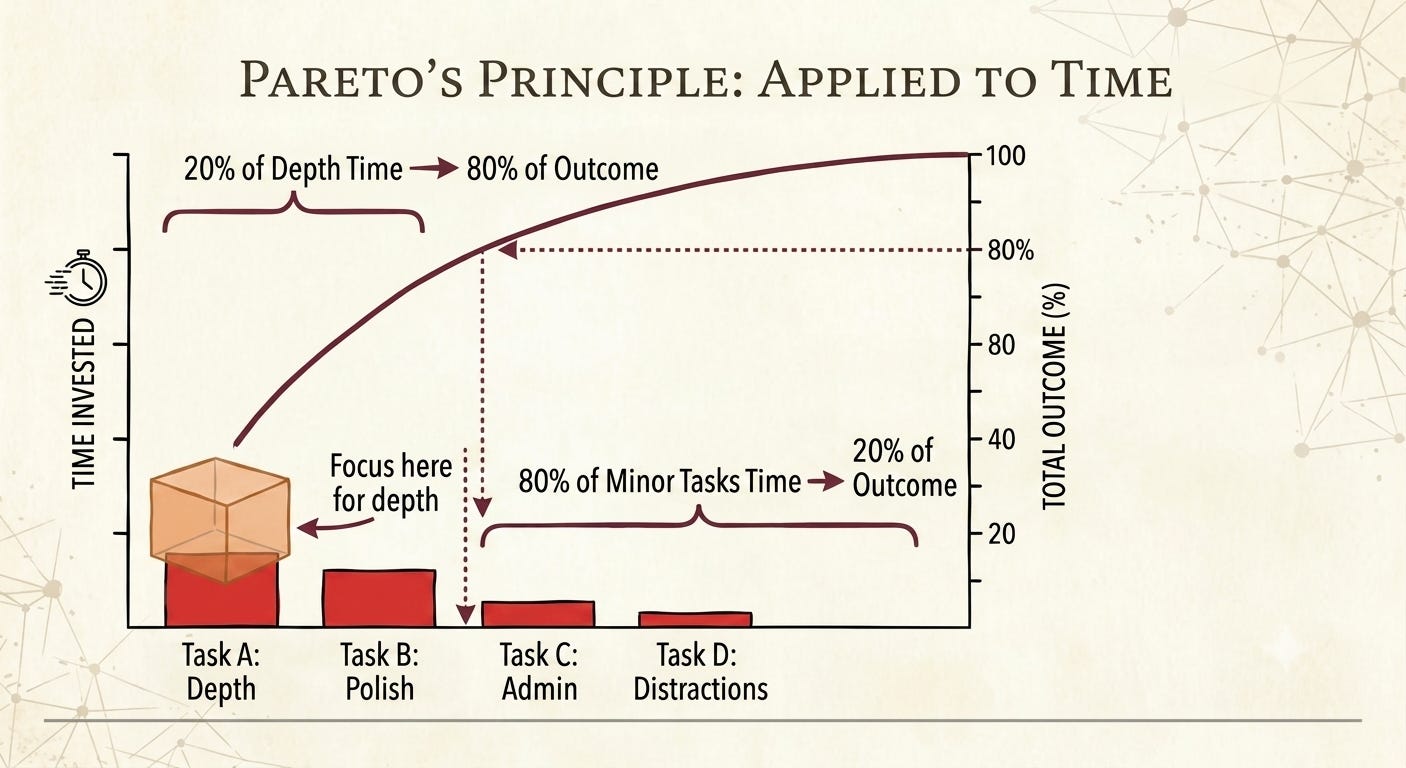
1. Management & Systems Action
· Team Dynamics: 80% of team friction most likely stems from 20% of the team members. Identifying that 20% allows you to act early and effectively rather than spreading your energy too thin across the many.
· Service Delivery: 20% of your clients or customers often account for 80% of your turnover or service activity. Analysing this allows you to redistribute tasks across your team.
· The Perfection Tax: For the perfectionist, 80% of a task is usually completed in the first 20% of the time. The final 20% of the “polish” will eat 80% of your remaining time.
· The Question: Is that last piece of perfection worth the 80% time-tax, or is it “Good Enough” now?
2. The Digital Overlay: Pareto in the Machine
In the Era of the Digital Pulse, the machine is designed to make everything feel like a 100:100 priority. We can apply the 80:20 rule to our digital lives to avoid algorithmic drift.
The Information Diet: 80% of your digital notifications create 20% of value. Identify your “Vital 20%” of sources—the deep thinkers and essential feeds. Silence the 80% by deleting or unsubscribing to the rest. Focus on your 20%.
The App Audit: We spend 80% of our screen time on 20% of our apps. Audit your home screen; keep the vital 20% of apps visible and move the “vampire apps” into folders or delete them.
The Infinite Scroll: We spend 80% of our time writing a document long after the core value has been created. Use the Principle of Good Enough to send the report, email or publish the post.
The algorithm will tempt you into a “perfection loop” that eats your time without adding human value. The Pareto Principle is how you remind the yourself that you decide what matters.
“Using the Pareto Principle changed my relationship with my calendar. I now set a hard one-hour limit for a task. I stop 15 minutes in to check: Is this good enough yet? It very often is. The rest of the hour is reclaimed for thinking, breathing, and genuine human connection.”
Revisit your “To-Do” list right now. Delete the 80% that doesn’t produce the 20% of your impact.
Reference: The 80/20 Principle by Richard Koch (1997).