

Dr. Caroline Whalley, CBE
Surface-Level System Tweaks Don’t Work
“We are experiencing a structural transition in how children learn and engage.”
Surface-level system tweaks don’t work. Adding minor rules, tweaking behaviour policies, or issuing top-down phone bans while leaving the industrial compliance model untouched is actively failing the next generation. In a world dominated by artificial intelligence and automated feeds, raising children to be obedient processors is a dead end to be challenged.
What our children, parents and schools need is a shift towards Defiant Humanism.
Defiant Humanism is a direct challenge. It demands that parents, schools, and policy makers stop treating children as passive receivers of instruction and start actively protecting, nurturing, and strengthening the Human Edge—those irreplaceable human capacities like critical questioning, empathy, emotional regulation, and self-directed agency that no technology can replicate.
And let’s stop the blame game. Exhausted parents are blamed for screen time they were never given the tools to manage, while overworked teachers are blamed for systemic disengagement they didn’t create. Pointing fingers between homes and schools achieves nothing while corporate algorithms continue to capture our and our children’s attention.
More guilt is unhelpful; we need a shared, actionable framework.
To lead this shift across both home and school, FUTUREPROOF: Parenting the AI Generation is now published and available on Amazon.
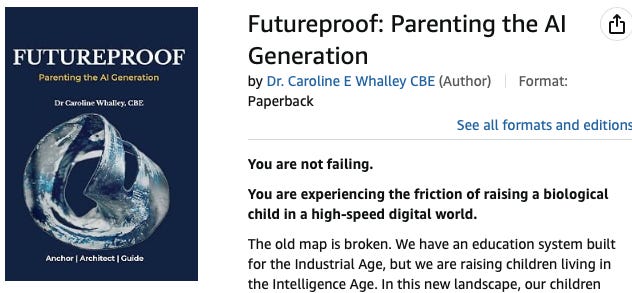
It provides parents with an immediate roadmap to challenge algorithmic capture and build real-world confidence. Five dedicated age-phase guides, spanning Early Years to Secondary KS4, are in pre-publication and will equip school leaders, teachers, SENDCOs, and all educators with the tools needed to begin to transform approaches to learning.
The Real Landscape: Digital Natives vs. Distracted Adults
Making this shift requires looking honestly at our daily environments without falling back on surface-level blame. The relationship between adults and young people is fracturing because we are operating in two completely different worlds:
Digital Natives: Children born after 2013 have never known an analogue baseline. Their developing brains are continuously interacting with responsive algorithms, infinite scrolling, and instant dopamine feedback.
Distracted Adults: Adults born before smartphones took over in 2013 are caught in “Collective Capture” (Haidt, 2024). While adults remember a pre-digital world, most now live in a state of constant partial attention.
This gap creates a severe risk: relational solitude. Children are routinely growing up alongside adults who are physically present in the room but relationally absent, absorbed by their electronic devices. When an adult anchor disappears into their own online feeds, children are left to navigate complex, addictive digital landscapes completely unguided.
Looking back at early broadcast media highlights how drastically we have broken this human connection. Programs like the BBC’s Watch with Mother (1955) were built on two intentional principles: watching together as a shared family moment, and clear, natural endings that returned the child to the real world. Modern personalised feeds do the exact opposite: they isolate every family member onto separate screens with infinite loops designed to ensure nobody ever stops watching.
Macro Autocracy vs. Micro Compliance
In her essential work on democratic fragility and autocratic systems, Anne Applebaum (@anneapplebaum) has consistently warned us of the political dangers of algorithmic manipulation and digital polarisation. She demonstrates how automated outrage weakens democratic discourse from the top down.
If we train a generation to obey external feeds, optimise for compliance, and surrender critical thought to predictive text, we are inadvertently building the psychological foundation for autocratic control. Defiant Humanism is the micro-rebellion. Reclaiming human agency at the bottom is our strongest defence against manipulation at the top.
Where does autocratic compliance truly begin?
It does not begin at the ballot box; it begins in the living room and classroom when we condition children to accept passive, algorithmic curation over their own biological sovereignty.
Blanket Bans Are a Partial Solution
Governments and schools are introducing smartphone bans during the school day. These boundaries are essential—they offer relief from relentless digital noise and restore quiet space for focus.
However:
Rules Do Not Build Internal Skill: A top-down ban stops a behaviour while a child is watched, but it fails to teach executive self-control, focus, or boundary-setting.
The Delayed Fall: If young people reach adulthood without ever practicing real choice or understanding their own attention, they remain completely defenseless against digital manipulation the moment external restrictions are removed.
We must shift to a Both/And approach: Firm, protective environmental boundaries PLUS explicit teaching on how the human brain handles digital stimuli. Children and their parents must be taught how our nervous systems react to all dopamine hooks, giving us the internal self-awareness to make intentional choices for ourselves.
Aligning the Shift: Statutory SEND Compliance and Ofsted Readiness
For schools, moving away from rigid compliance is not just a moral imperative—it is an urgent regulatory necessity.
The H5 Framework turns this shift into an explicit, evidence-based strategy that directly fulfils a school’s legal duties under the SEND Code of Practice (0–25 years) and aligns directly with Ofsted’s standalone Inclusion evaluation framework:
Adaptive Approaches not Curriculum Narrowing: Rather than pulling struggling pupils out of lessons or simplifying content, the Futureproof: Human Edge framework leans into Universal Design for Learning (UDL) (Think & Act) to adapt the learning environment, ensuring all learners—including those with SEND—access an ambitious curriculum.
Proactive Sensory and Stress Regulation: Under Ofsted’s evaluation of behaviour, attitudes, and inclusion, schools must demonstrate proactive strategies for supporting Social, Emotional, and Mental Health (SEMH) needs. The H5 model (Seen & Heard) provides immediate tools to de-escalate anxiety and the “Freeze” response before emotional dysregulation leads to exclusion.
Home-School Co-Production: The SEND Code mandates authentic partnership with families, in fact all children should have this pathway available. By linking Futureproof: Parenting the AI Generation for parents directly with the five upcoming school guides, education settings gain a unified, shared language for routines and regulation that bridges the gap between home and classroom.
The H5 Framework in Action

Point & Purpose (Thumb) – Visual Bypass & Clarity: Eliminates prefrontal cognitive overload by replacing dense verbal instructions with environmental structure and visual routines (Sweller, 2011).
Connect & Belong (Index) – Relational Safety: Down-regulates threat perception. Polyvagal theory proves that children cannot process academic learning when they feel relationally unsafe or isolated (Porges, 2011).
Seen & Heard (Middle) – Mitigating Stress Responses: Identifies emotional dysregulation early, teaching children physical and cognitive techniques to calm their nervous systems during the “Freeze” response (Siegel & Bryson, 2011).
Think & Act (Ring) – Separating Learning from Testing: Strictly decouples the exploratory Learning Phase (low-stakes, risk-tolerant) from the Testing Phase (evaluative) to protect intrinsic problem-solving drive (Rose & Meyer, 2002).
Reflect & Grow (Little Finger) – Restorative Accountability: Replaces shame and punitive control with the C.A.R.E. framework, building long-term internal locus of control, agency, and biological sovereignty (Zehr, 2002).
The Path Forward
We cannot wait for an outdated education system to fix itself, nor can we rely onbans to shelter our children from the digital age. In a political landscape defined by constant upheaval—where leaders and ministers move on before meaningful policy can ever take root—relying on top-down reform leaves our children stranded in short-term reactivity. We must act now to strengthen the Human Edge from the ground up.
With FUTUREPROOF: Parenting the AI Generation available today for families on Amazon, and our five age-phase school guides arriving shortly, we are offering a starting point that combines firm boundaries, clear brain awareness, and genuine human connection. My hope is that thinkers, educators, and communities across platforms like Substack will challenge these ideas, build upon them, and help them grow - every child must become an active, confident navigator of their own life.
Recommended Reading & References (APA 7th Edition)
BBC. (1955, September 9). The Woodentops [Television broadcast]. British Broadcasting Corporation.
Department for Education. (2015). Special educational needs and disability code of practice: 0 to 25 years (Statutory guidance). UK Government.
Gopnik, A. (2009). The philosophical baby: What children’s minds tell us about truth, love, and the meaning of life. Farrar, Straus and Giroux.
Haidt, J. (2024). The anxious generation: How the great rewiring of childhood is causing an epidemic of mental illness. Penguin Press.
Ofsted. (2025). The Education Inspection Framework: Inclusion and Report Card Evaluation Criteria. UK Government.
Porges, S. W. (2011). The polyvagal theory: Neurophysiological foundations of emotions, attachment, communication, and self-regulation. W. W. Norton & Company.
Rose, D. H., & Meyer, A. (2002). Teaching every student in the digital age: Universal design for learning. Association for Supervision and Curriculum Development.
Siegel, D. J., & Bryson, T. P. (2011). The whole-brain child: 12 revolutionary strategies to nurture your child’s developing mind. Delacorte Press.
Sweller, J. (2011). Cognitive load theory. The Psychology of Learning and Motivation, 55, 37–76.
Watkins, C., Carnell, E., Lodge, C., Wagner, P., & Whalley, C. (2000). Learning about learning: Resources for supporting effective learning. Routledge.
Whalley, C. (2024). FUTUREPROOF: Parenting the AI generation. H5 Learn 2050 Publishing.
Zehr, H. (2002). The little book of restorative justice. Good Books.